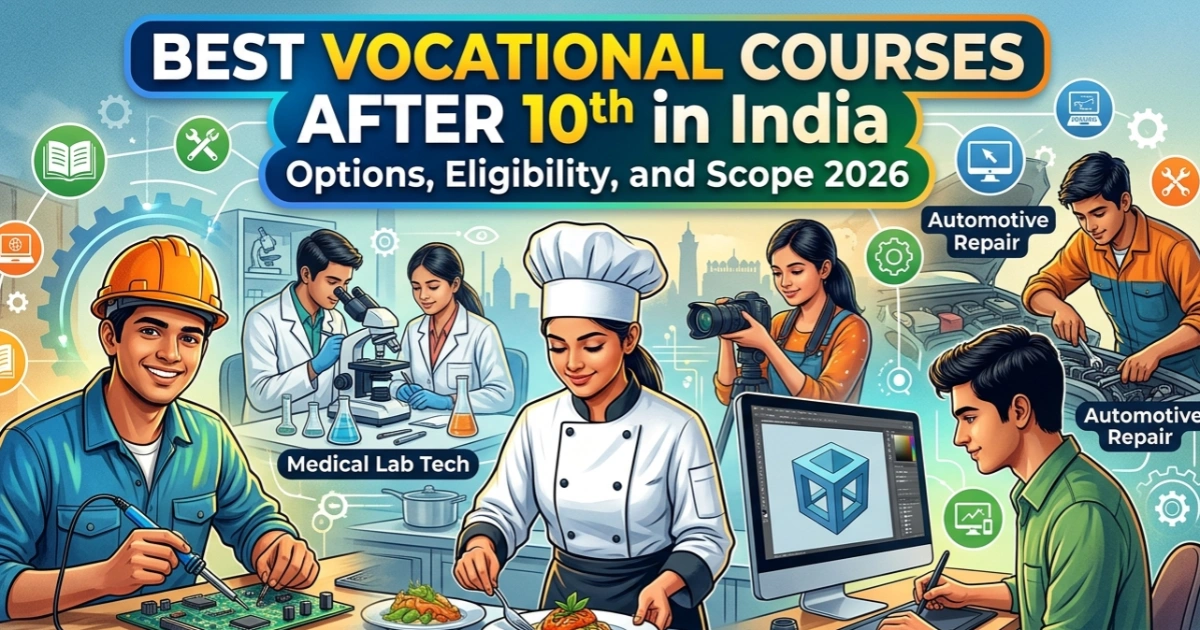
Best Vocational Courses After 10th in India: Options, Eligibility, and Scope 2026
Opting for Vocational Courses after 10th provides a practical and accelerated route to a fulfilling career, equipping students with job-specific skills directly relevant to industry demands. These programs are an excellent alternative to traditional academic paths, offering hands-on training and early entry into the workforce. Here, you’ll discover the best options, eligibility criteria, career scope, and how to select the perfect course for your future in 2026.
Vocational Courses After 10th: Eligibility Criteria and Admission Process 2026
The admission process for vocational courses after 10th varies significantly by institute, often based on Class 10th scores. Students generally need to have passed Class 10th, though some courses accept Class 8th pass students. Eligibility also includes specific age limits and, for some programs, minimum aggregate scores.
- Educational Qualification: Passed Class 10th; some courses accept Class 8th pass.
- Minimum Aggregate Score: 50% in the 10th standard for certain courses.
- General Age Eligibility: At least 14 years old and under 25.
- Admission Process: Varies significantly from institute to institute.
- Admission Basis: Often merit-based, using Class 10th scores.
- Application Method: Students can apply online or offline.
Beyond these general criteria, specific vocational courses after 10th may have additional requirements, including different age limits or subject prerequisites, and diverse admission pathways.
| Criterion | Details |
| Specific Subjects | Science, Mathematics, and English are required for some courses. |
| Age Eligibility (Range 2) | Minimum 15 years, maximum 18 years. |
| ITI Age Eligibility | 14 years to 40 years. |
| Admission by Entrance Exam | Some institutes conduct entrance exams testing knowledge and aptitude. |
| Admission by Direct Admission | Private colleges offer direct admission based on seat availability. |
| ITI Admission 2026 | Information regarding ITI Admission 2026 is available. |
These details highlight the varied and specific requirements across different vocational programs and institutes.
Career Scope and Salary Prospects After Vocational Courses 10th Pass 2026
Vocational courses after 10th provide a direct path to employment, combining theoretical knowledge with hands-on skills for specific careers. These skill-oriented programs offer industry-relevant knowledge and career flexibility across diverse sectors like healthcare, IT, and hospitality, preparing individuals for the 2026 job market.
| Options | Duration | Top career | Entry salary |
| Polytechnic Diploma | 3 years | Diploma Engineer | Rs. 2.5L to 5L |
| ITI Trade Course | 6 months to 2 years | Electrician, Fitter, COPA, Welder | Rs. 1.5L to 4L |
| Short Vocational Course | 3 to 6 months | Tally, Digital Marketing, Graphic Design | Rs. 1.2L to 3.5L |
| 10th-pass Govt Exam | 6 to 12 months prep | RRB Group D, SSC MTS, Army GD, SSC GD | Rs. 2.5L to 4.5L |
This table clearly illustrates the diverse career paths available after Class 10, highlighting the varying durations and potential starting salaries for vocational training and government job exams. It shows how different vocational courses after 10th can lead to distinct career opportunities and earning potentials.
Stream-Wise Vocational Courses After 10th: Arts, Science, Commerce Options 2026
After completing Class 10, students often assume that vocational courses are only for those who did not qualify for mainstream streams. That is a misconception. In 2026, some of the most in-demand and well-paying careers begin with a vocational course taken right after 10th, and the right course depends significantly on the stream a student is inclined towards — Arts, Science, or Commerce. Each stream opens up a distinct set of vocational pathways that align with both subject interest and career direction.
People Also Read



Science Stream — Vocational Courses After 10th
Students inclined towards biology, physics, chemistry, or technology have a wide range of practical and well-paying vocational options. Science-based vocational courses tend to lead into healthcare, engineering trades, and IT — all sectors with strong and consistent hiring demand.
| Course | Duration | Key Skills Covered | Avg. Starting Salary (₹/month) |
| ITI in Electrician | 2 years | Wiring, circuit repair, electrical safety | ₹12,000 – ₹22,000 |
| ITI in Fitter | 2 years | Machine fitting, tool maintenance, engineering drawings | ₹12,000 – ₹20,000 |
| ITI in Electronics Mechanic | 2 years | Electronic circuits, PCB repair, instruments | ₹12,000 – ₹20,000 |
| Diploma in Medical Lab Technology (DMLT) | 2 years | Lab testing, sample analysis, pathology basics | ₹10,000 – ₹18,000 |
| Pharmacy Assistant Certificate | 1 year | Drug dispensing, patient support, inventory | ₹10,000 – ₹16,000 |
| Nursing Assistant / Hospital Aide | 1 year | Patient care, basic nursing, hospital hygiene | ₹10,000 – ₹15,000 |
| IT/ITeS Certificate (NSQF Level 3) | 6 months – 1 year | Computer basics, data entry, internet skills | ₹12,000 – ₹18,000 |
| Diploma in Solar Energy Technology | 1 year | Solar panel installation, green energy systems | ₹14,000 – ₹22,000 |
| Automotive Service Technician (ITI) | 2 years | Vehicle repair, engine servicing, diagnostics | ₹12,000 – ₹20,000 |
Commerce Stream — Vocational Courses After 10th
Students with an interest in business, accounts, banking, and customer-facing roles will find commerce-oriented vocational programmes the most relevant. These courses prepare students for entry-level roles in retail, finance, logistics, and administration.
| Course | Duration | Key Skills Covered | Avg. Starting Salary (₹/month) |
| Certificate in Retail Management | 6 months – 1 year | Store operations, inventory, customer service | ₹10,000 – ₹16,000 |
| Diploma in Accounting & Tally | 6 months | Tally ERP, GST, basic accounts | ₹10,000 – ₹18,000 |
| Certificate in Banking & Finance Basics | 6 months | Banking operations, loans, financial products | ₹10,000 – ₹15,000 |
| Certificate in Business Correspondent (BC) | 3–6 months | Banking services, micro-lending, rural finance | ₹8,000 – ₹14,000 |
| Diploma in Logistics & Supply Chain | 1 year | Warehousing, inventory, dispatch management | ₹12,000 – ₹18,000 |
| Certificate in Digital Marketing | 6 months | SEO, social media, email marketing, ads | ₹12,000 – ₹20,000 |
| E-Commerce & Online Business Certificate | 6 months | Product listing, seller accounts, delivery logistics | ₹10,000 – ₹18,000 |
| Office Management & Secretarial Practice | 1 year | MS Office, communication, admin support | ₹10,000 – ₹15,000 |
Arts Stream — Vocational Courses After 10th
Arts students have the widest range of creative and people-facing vocational options. Courses in beauty, design, media, hospitality, and social work are all strong fits for students from an arts background. Many of these fields also reward personal style, communication skills, and creativity — natural strengths of arts-inclined students.
| Course | Duration | Key Skills Covered | Avg. Starting Salary (₹/month) |
| Diploma in Beauty & Cosmetology | 6 months – 1 year | Skincare, makeup, hair styling, nail art | ₹10,000 – ₹20,000 |
| Certificate in Fashion Designing | 6 months – 1 year | Sketching, garment making, fabric knowledge | ₹10,000 – ₹18,000 |
| Diploma in Hotel Management & Hospitality | 1 year | Food & beverage, front office, housekeeping | ₹10,000 – ₹18,000 |
| Certificate in Graphic Design | 6 months | Photoshop, Illustrator, logo and print design | ₹12,000 – ₹22,000 |
| Certificate in Photography & Videography | 6 months | Camera handling, editing, event photography | ₹12,000 – ₹25,000 |
| Certificate in Animation Basics | 6 months – 1 year | 2D/3D animation, storyboarding, motion graphics | ₹12,000 – ₹22,000 |
| Diploma in Early Childhood Care & Education | 1 year | Child development, teaching basics, playschool management | ₹8,000 – ₹15,000 |
| Certificate in Travel & Tourism | 6 months – 1 year | Tour planning, ticketing, customer service | ₹10,000 – ₹16,000 |
| Certificate in Yoga & Wellness Instructor | 3–6 months | Yoga teaching, anatomy basics, session planning | ₹10,000 – ₹20,000 |
Diploma vs Short-Term Vocational Courses After 10th: Duration and Focus 2026
Understanding the duration and focus of post-10th courses is crucial for career planning. Diploma courses typically offer a broad range of durations from 6 months to 3 years, while Short-Term Vocational Courses after 10th provide quicker pathways to employment with durations generally ranging from 6 months to 2 years.
| Course Type | General Duration Range | Specific Durations | Focus |
| Diploma Courses | 6 months to 3 years | Standard: 1 year to 3 years; Short Course: 6 months to 1 year | Practical learning, technical skills, early job opportunities, skill-based training in a specific field, practical knowledge rather than theory, industry readiness, and employability. |
| Short-Term Vocational Courses | 6 months to 2 years | Short-Term Certificate: 3-12 months; Bootcamp (2026 Trend): 3-6 months; Apprenticeship Training: 6 months to 4 years | Real-world skills, quick employment, hands-on training, applied learning, and helping students start earning early or build their own business. |
This table highlights that while diploma courses offer comprehensive skill-based training, Short-Term Vocational Courses After 10th are designed for rapid acquisition of real-world skills, enabling quick entry into the job market or entrepreneurship.
Vocational Course Fees and Top Training Institutes in India 2026
Exploring Vocational Courses After 10th in India reveals a wide range of options and fee structures. The reasonable course fee for many vocational programs after 10th typically falls between INR 10,000 and INR 1,50,000, making them accessible for many students.
- Reasonable Course Fee for Vocational Courses (after 10th): INR 10,000 to INR 1,50,000.
- Top Vocational Colleges after 10th: Delhi University’s College of Vocational Studies, ITIs, and Polytechnic Institutes.
- Total Vocational Colleges in India: 917 institutions.
- Privately owned Vocational Colleges in India: 1331 institutions.
- Fee Range for Top Vocational Colleges in India: INR 13 to INR 22,09,000.
- St. Xavier’s College Mumbai Vocational Course Fees: INR 11,240 – INR 39,326.
India’s vocational education landscape includes 199 government-run colleges, complementing the larger private sector. Institutions like NMIMS Mumbai (private unaided) and GGSIPU (public) offer vocational courses with fees around INR 1,51,000 and INR 2,82,000, respectively. Certificate courses after 12th, such as Digital Marketing or Medical Lab Technician, typically range from ₹20,000 to ₹70,000.
| Institution/Program | Status/Detail | Fee Information |
| St. Xaviers College Mumbai | Private | Total Fees (3 years, Aided courses): Rs 0.4 – 2.0 L |
| Fergusson College | Private Institute, established in 1895 | – |
| NMIMS Mumbai | Private Unaided | Total Fees (MBA Core): Rs 27 L |
| GGSIPU | Public | Total Fees: Rs 1.02-8.51 L |
These details highlight the varied fee structures and institutional statuses among India’s leading vocational education providers.
How to Choose the Best Vocational Course After 10th for Your Career 2026
Choosing the right vocational course after 10th is one of the most important decisions a student can make, especially in 2026 when skill-based careers are growing faster than ever. With hundreds of options across trades, technology, healthcare, beauty, and business, the right choice depends on a combination of personal interest, career goals, local job market demand, and available budget. Picking a course just because it is popular or affordable without matching it to your strengths is one of the most common mistakes students make at this stage.
Step-by-Step Guide to Choosing the Right Vocational Course
Step 1 — Identify your interests and strengths
The first and most important filter is what you genuinely enjoy. Vocational courses require consistent hands-on practice, so interest and aptitude matter more here than in academic programmes. Ask yourself whether you are more comfortable working with tools, people, technology, creativity, or numbers.
Step 2 — Research career scope and job demand
Once you have shortlisted interest areas, research which careers are growing in your state or city. For example, healthcare support roles, IT trades, automotive servicing, and electrician trades have strong and consistent demand across India. Beauty and fashion careers also have high scope in urban areas.
Step 3 — Check government recognition and certification validity
Always prefer courses certified by recognised bodies such as the National Skill Development Corporation (NSDC), National Council for Vocational Education and Training (NCVET), ITI-affiliated boards, or the Ministry of Skill Development. A government-recognised certificate carries more value with employers and can help in government job applications.
Step 4 — Compare fees and return on investment
Vocational courses range from completely free government-funded programmes to private courses costing ₹1–2 lakh. Before paying, check average starting salaries for the role in your city. A course that costs ₹80,000 but leads to a ₹20,000/month job is a better investment than a ₹30,000 course that leads to a ₹8,000/month job.
Step 5 — Check placement and internship support
Courses that include live internships, on-the-job training, or guaranteed placement assistance give students a significant advantage. Always ask the institute for placement records and recruiter tie-ups before enrolling.
Step 6 — Consider further education pathways
Some vocational courses allow you to continue into diploma or degree programmes later. For example, an ITI certificate holder can apply for lateral entry into polytechnic diploma programmes, and some vocational routes lead into B.Voc degrees under the National Education Policy (NEP) 2020.
Vocational Course Selector by Interest Area
| Interest Area | Recommended Course | Duration | Avg. Starting Salary (₹/month) |
| Technology & IT | IT/ITeS (NSQF Level 3–4), Hardware & Networking | 6 months – 1 year | ₹12,000 – ₹20,000 |
| Healthcare support | ANM, Nursing Assistant, DMLT, Pharmacy Assistant | 1–2 years | ₹10,000 – ₹18,000 |
| Electrical & mechanical | Electrician, Fitter, Mechanic (ITI trades) | 1–2 years | ₹12,000 – ₹22,000 |
| Beauty & wellness | Beauty & Cosmetology, Hair Styling, Nail Art | 6 months – 1 year | ₹10,000 – ₹20,000 |
| Hospitality & food | Food & Beverage Service, Baker & Confectioner | 6 months – 1 year | ₹10,000 – ₹18,000 |
| Retail & business | Retail Management, Banking Basics, Accounting | 6 months – 1 year | ₹10,000 – ₹16,000 |
| Creative & media | Graphic Design, Photography, Animation basics | 6 months – 1 year | ₹12,000 – ₹25,000 |
| Agriculture & livestock | Animal Husbandry, Agriculture Technology | 1–2 years | ₹8,000 – ₹15,000 |
Government vs Private Vocational Course: Which Is Better?
| Parameter | Government / ITI Course | Private Institute Course |
| Fees | ₹0 – ₹10,000 (heavily subsidised) | ₹10,000 – ₹2,00,000 |
| Recognition | NCVT/SCVT nationally recognised | Varies by institution |
| Placement support | Moderate | Often stronger in premium institutes |
| Infrastructure | Basic to moderate | Usually modern and well-equipped |
| Course flexibility | Fixed batches and schedules | More flexible |
| Best for | Students with tight budgets | Students seeking better facilities |
Frequently Asked Questions
What exactly are vocational courses available after 10th grade?
Vocational courses after 10th are short-term and diploma programs that train students in a variety of fields, offering early job opportunities. These diversified options are in high demand.
How can I apply for vocational courses after completing my 10th standard?
Apply directly to institutes offering vocational courses after 10th. The admission process typically involves submitting your 10th standard marks and completing the application form.
What career opportunities and job prospects exist after completing these vocational courses?
Completing vocational courses after 10th offers direct employment opportunities in diverse sectors like healthcare, technology, design, IT, hospitality, and business, providing industry-relevant skills for early workforce entry.
How do vocational courses differ from traditional academic paths after 10th?
Vocational courses after 10th offer practical, hands-on training for specific trades, providing a direct path to employment. They are shorter and more cost-effective than traditional academic paths.
When do registrations typically open for vocational courses after the 10th board exams?
Registrations for vocational courses after the 10th typically open after the 10th board exam results are declared, usually from May to July.